
Take-Two Interactive (TTWO): Investment Memo
Reading GTA VI's steady-state economics from the share price
October 14, 2026 | Price $208.82 (close, October 12, 2026) | Market cap $39.05bn | Author: David Zhou
Summary
Conclusion: we are positive on Take-Two. Working back from the current price of $208.82, a 10% annual return through FY29 (April 2028 to March 2029) requires GTA VI Online to reach about 44.5m annual active players spending about $41 each a year. We expect it to clear that bar comfortably. On players, we expect 10–20% more than the 44.5m reference, or about 49–53m, because a larger share of GTA VI buyers will move into Online than did with GTA V. On ARPU, we expect $60–70 or more, because a larger share of those players will pay, mostly through GTA+. We have no differentiated view on the valuation multiple and use 22.5x FY29 EV/FCF. On these assumptions GTA VI Online books $2.9–3.7bn in FY29, 1.6–2.0 times the $1.83bn the price requires, and Take-Two is worth $247–274 per share today, 18–31% above the current price, or about 18–23% a year to FY29. All of the excess return comes from operating results; none of it depends on a higher multiple. The main risks are a late or troubled Online launch and a hardware barrier that limits the player base.
GTA VI goes on sale in a little over a month. Rockstar will release it on PS5 and Xbox Series X|S on November 19, 2026, 13 years after GTA V and after two delays. Player interest has few precedents in the industry: the first trailer, released in December 2023, drew more than 90m YouTube views in 24 hours, and the second, in May 2025, drew 475m views across platforms in its first 24 hours. GTA V has shipped more than 225m copies and GTA Online is still running, so many players have waited more than ten years for the sequel. Investors are waiting too. Over the past year the stock has traded between $188 and $266 as delays and expectations shifted, and most of the debate is about launch units and pricing. This memo takes a different route: we first read what the current price already assumes, then judge whether those assumptions are likely to be met.
• FY29 FCF implied by the price (22.5x exit, 10% a year): About $2.26bn
• Of which GTA VI Online must provide: About $0.70bn of FCF, or about $1.83bn of bookings
• Implied Online hurdle: 44.5m annual players × $41, or 51m × $36
• Our base case: 51m players × $65 ARPU; FY29 FCF about $2.83bn
• Base case value today: About $260 per share, 25% above the price; about 20% a year to FY29
• Our range (49–53m players, $60–70 ARPU): $247–274 per share
• Scenario values today: Downside $129, conservative $195, base $260, bull $291
We start from the share price rather than from a forecast of GTA VI unit sales. Compounding today's market value at 10% a year to the end of FY29 gives the equity value shareholders need. After adding the cost of share dilution and deducting the net cash that GTA VI's launch will leave on the balance sheet, Take-Two's operating business must be worth about $50.8bn, which at 22.5x requires about $2.26bn of FY29 free cash flow. The non-GTA business, GTA VI's single-player tail and what remains of GTA V can supply about $1.55bn. The remaining $0.70bn has to come from GTA VI Online.
The launch itself matters less to the valuation than the public debate suggests. We estimate that GTA VI's first two fiscal years of single-player sales (about 60m units) will generate about $1.96bn of cash, but that cash is counted once, not capitalized at 22.5x. Each additional 15m launch units adds only about $2 per share today. Each additional 5m stable Online players adds about $11.
Our base FY29 FCF of $2.83bn is about 42% above market consensus, and almost all of the gap is GTA VI Online. The central question of this memo is therefore whether Online can hold enough players once it reaches a steady state. Ranked by effect on value, the variables to track are stable player numbers, the exit multiple, the non-GTA FCF margin and ARPU. GTA V Online cannibalization and launch unit sales matter little.
The main risks are a delayed or poorly received GTA VI Online, launch quality problems, a hardware barrier from rising console and memory prices, and whether the non-GTA business recovers after a decline in FY27. If the stock fell below about $195 (the 52-week low is $187.63), even our conservative case would return about 10% a year.
1. Method: Reading Expectations from the Share Price
1.1 Expectations investing
This memo uses the approach Alfred Rappaport and Michael Mauboussin set out in Expectations Investing. The usual way to value a company is to forecast its results, compute an intrinsic value and compare it with the price. The weakness is that the conclusion is anchored on our own forecast, and we rarely have grounds to believe our forecast is better than the market's.
Expectations investing reverses the order. The share price already reflects the market's view of future cash flows, so the first step is to read that view: what revenue, margins and investment efficiency the company must deliver to justify the price. The second step is to find the operating variables most likely to differ from that view and with the largest effect on value, which the book calls value triggers; the most important of them is the turbo trigger. Only the third step is a decision: whether the gap between the implied expectations and our own judgment is large enough to cover the risks and the opportunity cost. On this view an investment opportunity comes not from the company being good but from expectations being too low.
1.2 Applying it to Take-Two
The book's standard tool is a reverse DCF that solves for the growth rate and forecast horizon implied by the price. That does not suit Take-Two today. GTA VI's launch will distort FY27 and FY28 cash flows: one-time unit sales, heavy software amortization and concentrated marketing all fall in those two years, and any explicit DCF would be driven by assumptions about them.
We use a simpler version. We take FY29, when the launch effect has largely faded, as the steady-state year. We compound today's market value at the required return to the end of FY29, adjust for share dilution and for the net cash the company will hold by then, and divide by a mature EV/FCF multiple. The result is the free cash flow FY29 must deliver.
Required FY29 FCF = [Market cap × (1 + r)^t × (1 + dilution) − Net cash at start of FY29] ÷ FY29 EV/FCF
Here r is the required return, 10%, and t is the time from today to the end of FY29 (March 2029), about 2.5 years. Net cash at the start of FY29 is today's net debt plus the one-time cash from GTA VI's launch (Section 4.2). With the cash hurdle in hand we work down in layers. We first deduct the parts we can estimate with some confidence; the remainder is the cash flow the market requires from GTA VI Online, which we convert into Online bookings and finally into two operating metrics that can be observed and tracked, annual active players and ARPU.
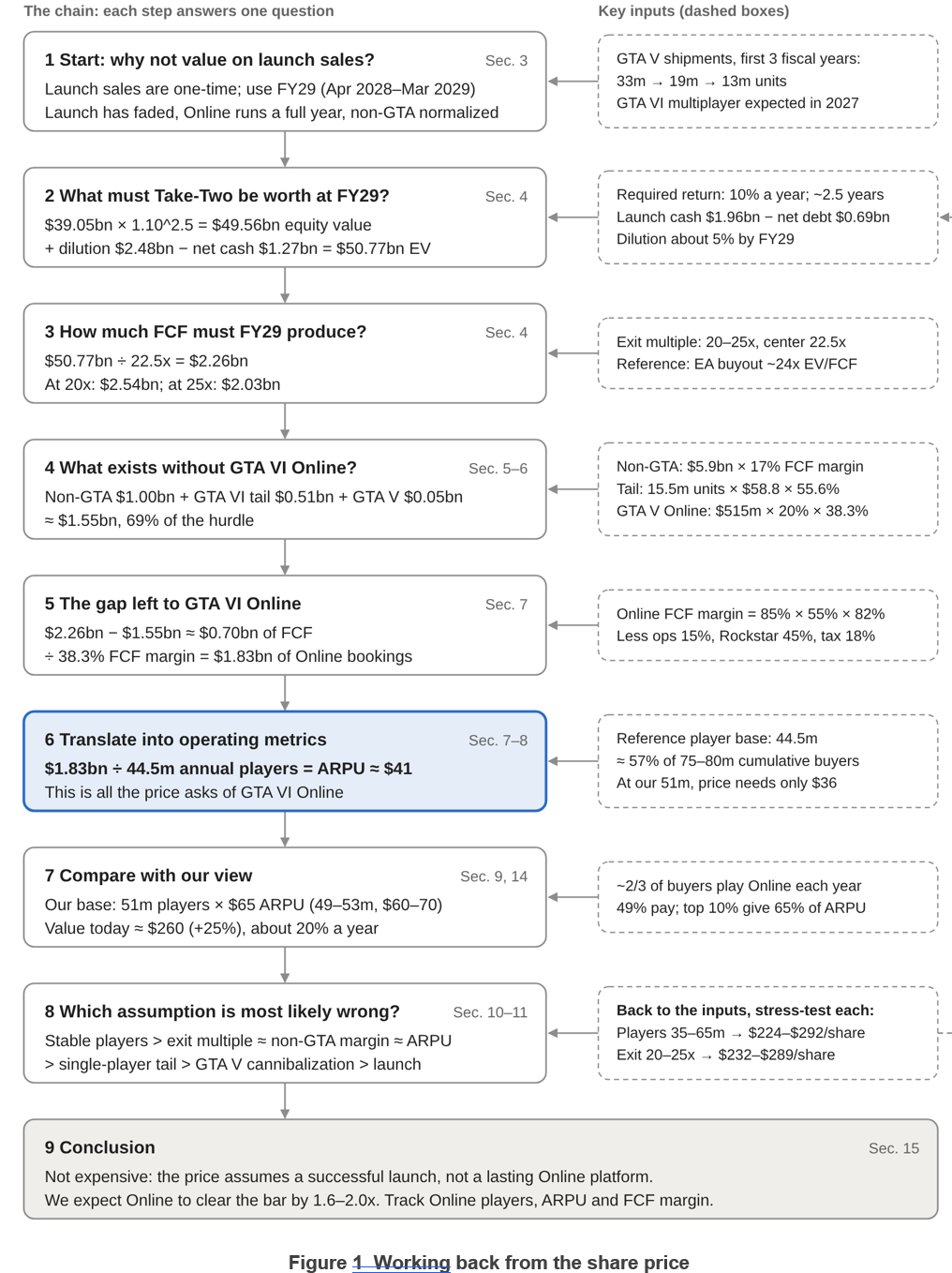
This approach does not require us to forecast how many copies GTA VI will sell. It only requires an answer to a question that is easier to test: can GTA VI Online reach a player base and ARPU above the hurdle in its steady state, and by how much? Figure 1 shows the full chain. Each step answers one question and lists the inputs it uses.
Figure 1: Working back from the share price
Step 1. Start: why not value on launch sales? (Section 3) Launch sales are one-time, so we use FY29 (April 2028 to March 2029), when the launch has faded, Online runs a full year and the non-GTA business is back to normal. Input: GTA V shipped about 33m, 19m and 13m units in its first three fiscal years; GTA VI multiplayer is expected in 2027.
Step 2. What must Take-Two be worth at FY29? (Section 4) $39.05bn × 1.10^2.5 = $49.56bn of equity value; adding dilution of $2.48bn and deducting net cash of $1.27bn gives a target enterprise value of $50.77bn. Inputs: 10% required return over about 2.5 years; launch cash $1.96bn less net debt $0.69bn; dilution about 5% by FY29.
Step 3. How much FCF must FY29 produce? (Section 4) $50.77bn ÷ 22.5x = $2.26bn; $2.54bn at 20x and $2.03bn at 25x. Inputs: exit multiple of 20–25x, centered on 22.5x; EA buyout at about 24x EV/FCF.
Step 4. What exists without GTA VI Online? (Sections 5–6) Non-GTA $1.00bn + GTA VI single-player tail $0.51bn + GTA V $0.05bn ≈ $1.55bn, 69% of the hurdle. Inputs: non-GTA $5.9bn × 17% FCF margin; tail 15.5m units × $58.8 × 55.6%; GTA V Online $515m × 20% × 38.3%.
Step 5. The gap left to GTA VI Online. (Section 7) $2.26bn − $1.55bn ≈ $0.70bn of FCF; ÷ 38.3% FCF margin = $1.83bn of Online bookings. Input: Online FCF margin = 85% × 55% × 82% (after 15% operating costs, Rockstar's 45% share and 18% tax).
Step 6. Translate into operating metrics. (Sections 7–8) $1.83bn ÷ 44.5m annual players = ARPU of about $41. This is all the price asks of GTA VI Online. Inputs: 44.5m is a reference player base, about 57% of 75–80m cumulative buyers; at our 51m the price needs only $36.
Step 7. Compare with our view. (Sections 9 and 14) Our base is 51m players × $65 ARPU (range 49–53m and $60–70); value today is about $260 (+25%), about 20% a year. Inputs: about two-thirds of buyers play Online each year; 49% of players pay, and the top 10% provide 65% of ARPU.
Step 8. Which assumption is most likely wrong? (Sections 10–11) Stable players matter most, followed by the exit multiple, the non-GTA margin and ARPU, then the single-player tail, GTA V cannibalization and launch sales. Stress tests: players of 35–65m give $224–292 per share; an exit of 20–25x gives $232–289.
Step 9. Conclusion. (Section 15) Not expensive: the price assumes a successful launch, not a lasting Online platform. We expect Online to clear the bar by 1.6–2.0x. Track Online players, ARPU and the FCF margin.
2. Company Overview and GTA VI Timeline
Take-Two has three main businesses: Rockstar Games (GTA, Red Dead Redemption), 2K (NBA 2K, Borderlands, Mafia, Civilization, BioShock and others) and Zynga's mobile games. In FY26 (April 2025 to March 2026) net bookings were $6.72bn, up 19%. Recurrent consumer spending (RCS) was 78% of the total and mobile 49%. GTA VI launches on November 19, 2026, and the company guides FY27 net bookings to $8.0–8.2bn.
• Share price (close, October 12, 2026): $208.82; market cap $39.05bn; about 187m shares
• 52-week range: $187.63–$265.94; current price about 21% below the high
• FY26 net bookings: $6.72bn, up 19%; RCS 78%; mobile 49%
• FY26 GAAP net revenue: $6.66bn; GTA products 12.4%, about $0.83bn
• FY26 operating cash flow: $0.62bn (FY25: −$0.05bn, mainly because of GTA VI development spending)
• FY27 guidance: Net bookings $8.0–8.2bn; operating cash flow above $1.0bn; capex about $0.29bn
• Balance sheet (June 30, 2026): Cash and short-term investments $1.83bn; debt $2.52bn; net debt about $0.69bn
• Cumulative sales: GTA V above 225m units; GTA franchise above 465m; Red Dead Redemption 2 above 85m
GTA VI will launch on PS5 and Xbox Series X|S at $79.99 for the standard edition and $99.99 for the Ultimate edition; pre-orders opened on June 25, 2026. It launches as a single-player game, and Rockstar has not announced a timetable for the online mode. Twitch's CEO said in September 2026 that multiplayer is expected in 2027, but Rockstar has not confirmed this. At the September annual meeting Zelnick said the existing GTA Online will keep running after GTA VI's multiplayer arrives. No PC version has been announced; GTA V's PC version came about 19 months after the console release.
The stock has been under pressure this year for three reasons: the November 2025 delay of GTA VI from May to November 2026; concern, after Google released its generative world model Project Genie in late January 2026, that AI could upend game development, which sent TTWO down more than 11% intraday; and the long wait before launch. The current price has already given up some of the optimism, which makes this a good time to re-read the expectations in it.
3. Why FY29 Is the Steady-State Year
The most common mistake in analysing Take-Two is to treat GTA VI's launch sales as long-term earning power. Launch sales are essentially a one-time software sale. Long-term value depends on how many active players GTA VI Online keeps after the sales peak, how much recurring revenue each of them contributes a year, and how much free cash flow 2K and Zynga eventually produce.
FY29 is GTA VI's third fiscal year and the first that meets three conditions:
1. Single-player sales have settled into a tail. Based on the company's cumulative shipment disclosures, GTA V shipped about 33m, 19m and 13m units in its first, second and third fiscal years. Third-year sales were still substantial but less than half the first year.
2. Online is in its first full year. GTA VI launches as a single-player game and multiplayer is expected in 2027, so FY28 is the launch and ramp year and FY29 the first full year of operation. Rockstar has not confirmed this timing, and it is an important premise of the analysis.
3. The PC version is probably out. On GTA V's timetable, the PC version would arrive in FY28 or FY29 and support the FY29 single-player tail.
FY29 still includes some one-time sales, but it is close to the economics of running a game platform. Valuing on FY27 would treat one-time revenue as recurring and overstate long-term earning power; valuing on FY28 would understate an Online business that is still ramping. The one-time cash from the launch years is not ignored: Section 4.2 adds it to the balance sheet.
4. Step One: The FY29 Cash Flow the Price Requires
4.1 Required equity value
At a 10% required return, today's $208.82 must be worth at least $208.82 × 1.10^2.5 = $265.0 by the end of FY29, which takes market value from $39.05bn to about $49.56bn. This is equity value, not the value of the operating business. To get from one to the other we need to account for how the balance sheet and share count will change over the next 2.5 years.
4.2 From equity value to enterprise value: launch cash, net debt and dilution
Three items matter. The first is the one-time cash from GTA VI's launch. We define the launch period as FY27 (from the November 19, 2026 release to March 2027) and FY28.
• Units. GTA V shipped about 52m units in its first two fiscal years. We add about 15% and assume GTA VI sells about 60m units over FY27 and FY28, of which about 32m in FY27. The FY27 figure is broadly consistent with guidance: FY27 net bookings guidance of $8.0–8.2bn and Rockstar's roughly 37% share give Rockstar about $3.0bn, and after about $1.0bn from GTA V and Red Dead, GTA VI contributes about $2.0bn.
• Price. Discounting is limited during the launch period. After platform and retail fees we use a net price of $61 per unit, so bookings over the two years total about $3.66bn.
• Costs. We use the single-player cost structure from Section 5.2 but raise marketing from 5.6% to 10% of bookings to reflect the launch campaign.
• Profit and cash. After product costs ($0.25bn), marketing ($0.37bn), amortization of capitalized development ($1.07bn), Rockstar's 45% profit share ($0.89bn) and 18% tax ($0.20bn), net income from the launch is about $0.89bn. Cash generated is about $1.96bn, well above net income. The difference, about $1.07bn, is amortization of GTA VI's development costs. That money was spent in earlier years and is already reflected in today's balance sheet, so it does not leave the company again.
• Range. At 45m to 75m units, launch cash is $1.5–2.5bn.
The second is today's net debt. At June 30, 2026, cash and short-term investments were $1.83bn and debt $2.52bn, leaving net debt of about $0.69bn. Shareholders buy the equity; the debt has to be covered by the value of the operating business.
The third is dilution from stock-based compensation. Our FCF is measured before stock-based compensation, so its cost shows up as dilution instead. The company's FY27 diluted share count guidance is about 2% above FY26, or about 5% cumulatively by the end of FY29. For each share to earn 10% a year, FY29 equity value has to be about $2.48bn higher.
From required equity value to target enterprise value:
• FY29 required equity value ($39.05bn × 1.1^2.5): $49.56bn
• Add: dilution from stock-based compensation (about 5%): +$2.48bn
• Less: GTA VI launch cash (FY27–FY28): −$1.96bn
• Add: net debt (June 30, 2026): +$0.69bn
• FY29 target enterprise value: $50.77bn
The target enterprise value is about $1.2bn above the simple equity figure. The launch cash is real, but net debt and dilution more than absorb it. Two sources of cash are left out, which makes the estimate conservative. The first is cash from the other businesses in FY27 and FY28. FY27 guidance calls for operating cash flow of just over $1.0bn, including part of GTA VI's launch receipts, which suggests that little is left once GTA VI Online and Rockstar's next projects are funded. The second is cash generated in FY29 itself. That year's cash flow is the basis of the valuation, and we do not count it a second time as cash on hand.
The bridge also shows why launch sales matter less than the attention they get. One-time cash is worth about a dollar per dollar, while steady-state cash flow is worth 22.5 dollars. Selling 75m units over the two launch years instead of 60m adds about $0.49bn of cash, or about $2 per share today.
4.3 The FCF hurdle
Dividing the target enterprise value by a range of mature EV/FCF multiples gives the FY29 FCF hurdle:
• 20x: Required FY29 FCF: $2.54bn; Per share (about 187m shares): $13.57
• 22.5x (center): Required FY29 FCF: $2.26bn; Per share (about 187m shares): $12.06
• 25x: Required FY29 FCF: $2.03bn; Per share (about 187m shares): $10.86
We use an exit multiple of 20–25x, centered on 22.5x, for three reasons. First, EA's take-private closed on August 4, 2026 at $210 per share, an enterprise value of about $55bn. EA's FY26 operating cash flow was $2.55bn; less about $0.23bn of capex, FCF was about $2.3bn, so the deal was priced at about 24x EV/FCF. That is a control price for a mature publisher with mostly recurring revenue, and it includes a control premium. Second, the peer references in our model show Capcom at about 25x FY28E earnings and EA at about 24.6x forward earnings before the buyout. Third, according to StockAnalysis, TTWO trades at about 26x forward earnings today, which includes a pre-launch growth premium. Once growth has been delivered in FY29, bringing the multiple back to 20–25x is reasonable and slightly cautious. We have no differentiated view on the multiple; 22.5x is simply the middle of this range.
5. Step Two: Cash Flow Outside GTA VI Online
Even if GTA VI Online contributed nothing, Take-Two would have about $1.55bn of FCF in FY29, about 69% of the 22.5x hurdle.
• Non-GTA (2K, Zynga, Red Dead and other): FY29 bookings: $5.90bn; FCF margin: 17%; FY29 FCF: $1.003bn; Basis: Back to the FY26 level; see Section 6
• GTA VI single-player tail (15.5m units × $58.8): FY29 bookings: $0.91bn; FCF margin: 55.6%; FY29 FCF: $0.507bn; Basis: GTA V third fiscal year about 13m units, plus about 20%
• GTA V Online residual (80% cannibalized): FY29 bookings: $0.10bn; FCF margin: 38.3%; FY29 FCF: $0.039bn; Basis: FY26 about $515m
• GTA V single-player residual: FY29 bookings: About $0.017bn; FCF margin: About 35%; FY29 FCF: $0.006bn; Basis: Small
• Total: FY29 bookings: About $6.93bn; FCF margin: 22.4%; FY29 FCF: $1.555bn
5.1 Non-GTA business
The non-GTA business contributes about $1.00bn of FY29 FCF, from $5.90bn of bookings at a 17% FCF margin. That is about 44% of the 22.5x hurdle and the largest single block. Section 6 covers the revenue assumption, the pipeline and the margin.
5.2 GTA VI single-player tail
We do not assume GTA VI has stopped selling by FY29. GTA V shipped about 13m units in its third fiscal year, including the PC launch. We add about 20% and use 15.5m units, reflecting GTA VI's higher profile and larger potential audience. The timing of the PC version directly affects this number; see Sections 10 and 13.
Net ASP is $58.8. We assume a 6:4 mix of standard and Ultimate editions, an average list price of about $88, about $62 after roughly 30% platform and retail fees, and about $58.8 after third-year discounting. FY29 single-player bookings are therefore about $0.91bn.
The 55.6% FCF margin is built as follows. Product costs are about 6.9% of bookings, marketing and G&A about 5.6% and software amortization about 29.4%. From the resulting profit we deduct Rockstar's GTA-linked profit share (we assume 45%, leaving 55% to Take-Two) and an 18% tax rate. Rockstar is wholly owned, but this share represents royalty and bonus pools tied to profit; it is a real cash cost to shareholders and the largest discount we apply to all GTA-related margins. GTA VI's development costs were capitalized and paid in earlier years, so FY29 amortization is non-cash and is added back.
Single-player FCF margin = (1 − 6.9% − 5.6% − 29.4%) × 55% × (1 − 18%) + 29.4% ≈ 55.6%
The single-player tail therefore contributes about $0.91bn × 55.6% ≈ $0.507bn of FCF.
5.3 GTA V Online cannibalization
We estimate that of the GTA franchise's roughly $0.83bn of FY26 revenue, about $0.31bn was GTA V single-player (about 15m units a year at about $20 net) and about $515m was GTA Online including GTA+. Management described GTA Online revenue in FY26 as growing slightly.
Once GTA VI Online launches, players will migrate from the old game. A player who spent $100 a year in GTA V Online and moves to GTA VI Online spending $120 adds only $20 of new revenue for Take-Two. The model therefore cannot simply add GTA V Online's $515m to GTA VI Online's revenue without double counting the players who migrate.
Our base assumption is that GTA VI replaces 80% of GTA V Online's monetization. The new map, graphics, content and a larger community will pull players across, but the old Online will keep running and players still on PS4 and Xbox One cannot move, so we do not assume 100%. The remaining bookings of about $103m contribute about $39m of FCF at a 38.3% margin. The four items total $1.003bn + $0.507bn + $0.039bn + $0.006bn = $1.555bn.
6. Non-GTA Business: Portfolio, Pipeline and Growth Assumption
We assume FY29 non-GTA bookings of $5.90bn, roughly flat on FY26. That looks conservative but is not loose. FY26 was a high base, the company's FY27 guidance implies a decline of about 10% in the non-GTA business, and getting back to the FY26 level by FY29 depends on the FY28–FY29 pipeline delivering.
6.1 Composition and history
Take-Two's non-GTA business has three parts: 2K's console and PC games, centered on NBA 2K and including Borderlands, Mafia, Civilization, WWE 2K and PGA TOUR 2K; Zynga's mobile games, including Toon Blast, Toy Blast, Match Factory!, Color Block Jam and Empires & Puzzles; and Rockstar's titles other than GTA, mainly Red Dead Redemption. FY26 mobile net bookings were $3.30bn, 49% of the company total.
The annual reports disclose GTA products' share of net revenue, from which non-GTA revenue can be estimated:
• FY23: GAAP net revenue: $5.35bn; GTA share: 14.6%; GTA revenue (est.): $0.78bn; Non-GTA revenue (est.): $4.57bn
• FY24: GAAP net revenue: $5.35bn; GTA share: 14.7%; GTA revenue (est.): $0.79bn; Non-GTA revenue (est.): $4.56bn; Change: −0.1%
• FY25: GAAP net revenue: $5.63bn; GTA share: 12.6%; GTA revenue (est.): $0.71bn; Non-GTA revenue (est.): $4.92bn; Change: +7.9%
• FY26: GAAP net revenue: $6.66bn; GTA share: 12.4%; GTA revenue (est.): $0.83bn; Non-GTA revenue (est.): $5.83bn; Change: +18.4%
Sources: Take-Two 10-K filings and earnings releases. GTA products exclude Red Dead. FY23 includes Zynga only from its consolidation on May 23, 2022.
Non-GTA revenue grew about 8.5% a year from FY23 to FY26, but the figure needs two adjustments. FY23 includes only about ten months of Zynga, so flat revenue in FY24 actually means organic revenue fell. And the growth is concentrated in FY26, an unusually strong year.
6.2 A high base in FY26 and a decline in FY27
FY26 benefited from several things at once. NBA 2K26 grew RCS by more than 30% for the year and had shipped more than 12m units by August 2026, up 9%. 2K released several large titles within a year, including Mafia: The Old Country, Borderlands 4 and Civilization VII. Mafia, priced at $50, beat internal expectations, and Zelnick called it a "massive hit". Mobile RCS grew 13%, Toon Blast, Match Factory! and Color Block Jam all set records, and Zynga's net bookings reached their highest level since the acquisition.
The same year had disappointments. Borderlands 4 launched below expectations; the company has not disclosed its sales, and the Switch 2 version has been paused. Civilization VII started slowly. Zelnick conceded in May 2026 that "we got it wrong" with Civ VII, and Firaxis cut staff in September 2025.
For FY27 the company guides net bookings of $8.0–8.2bn, with RCS flat on FY26, NBA 2K growing high single digits, and mobile declining because of Color Block Jam's high base and slower mature titles. On the label mix the company gave in August 2026 (Rockstar 37%, Zynga 34%, 2K 29%), Zynga and 2K together come to about $5.10bn in FY27. On the FY26 mix given in February 2026 (Zynga 46%, 2K 38%), the two came to about $5.65bn in FY26. In other words, the non-GTA business is expected to shrink by about 10% in FY27. In Q1 FY27 (April to June 2026) mobile RCS fell 7%, and the company guided total RCS down about 5% for Q2, consistent with this.
6.3 Development pipeline
The company says it has 29 titles in development through FY2029. Besides GTA VI, FY27 has six: two mobile titles, three sports titles (NBA 2K27, released on September 4, 2026, plus PGA TOUR 2K27 and WWE 2K27) and one platform port. FY28–FY29 has 22: one mobile title, five sports titles, three new IPs and 13 titles based on existing IP, of which seven are sequels and six are remakes, remasters or ports. The main known projects are:
• NBA 2K series: Developer: Visual Concepts (2K); Status: Annual release; NBA 2K27 is out; FY26 RCS up more than 30%; Our view: Cash core of the non-GTA business; management sees room to grow
• Next BioShock: Developer: Cloud Chamber (2K); Status: New studio head (Rod Fergusson) from August 2025, parts of the core design reworked; undated; Our view: Valuable brand but a troubled development; consider only after FY28
• Judas: Developer: Ghost Story Games; Status: In August 2025 the company expected release within about 12 months, but it is not on the FY27 slate; undated; Our view: Probably FY28 or later; limited scale
• Project ETHOS: Developer: 31st Union (2K); Status: Layoffs and a change of direction in May 2026; undated; Our view: High uncertainty; no growth assumed
• Mafia series: Developer: Hangar 13 (2K); Status: The Old Country beat expectations; Man of Honor expansion released in August 2026; Our view: A sequel could be one of the seven FY28–FY29 sequels
• Borderlands 4: Developer: Gearbox (2K); Status: Soft launch; ongoing paid content; Switch 2 version paused; Our view: Limited tail
• Max Payne 1&2 remake: Developer: Remedy, published by Rockstar; Status: In production; undated; Our view: Small; part of Rockstar
• Red Dead series: Developer: Rockstar; Status: Red Dead Redemption came to PS5, Xbox Series and Switch 2 in December 2025; RDR2 above 85m units; Our view: No new title announced; a long-dated option
• New mobile titles: Developer: Zynga; Status: Top Goal in soft launch; CSR 3 in development; Our view: Guidance assumes no new hits
Sources: Take-Two earnings releases and calls (August 2025 to August 2026), Variety, Insider Gaming, Video Games Chronicle.
The other side of the pipeline is cost and execution. Over the past year Cloud Chamber, Firaxis, 31st Union and Visual Concepts have all had layoffs, and in the June 2026 quarter the company took a $43.4m impairment on a third-party title it decided not to pursue. 2K's release cadence is uneven, and the number of titles in the pipeline cannot be read directly as revenue growth.
6.4 How we arrived at the growth assumption
We looked at three reference points. The first is history: non-GTA revenue grew about 8.5% a year from FY23 to FY26, but that cannot be extrapolated, because FY23 included only about ten months of Zynga and FY26 was the year NBA 2K26, Mafia: The Old Country and Borderlands 4 all launched. The second is FY27 guidance: on the August label mix, Zynga and 2K total about $5.10bn, and with about $0.25bn of Rockstar's non-GTA revenue the non-GTA business comes to about $5.35bn in FY27, about 10% below FY26. The third is our earlier model, which grew FY26 by 3% a year to about $6.37bn in FY29.
We use $5.90bn, a return to the FY26 level. From the FY27 low this requires about 5% annual growth in FY28 and FY29, below the 8.5% average of the past three years. Two things support it. NBA 2K is still growing: NBA 2K26 shipped more than 12m units, up 9%. And the company plans 22 releases in FY28–FY29, including three new IPs and seven sequels. We do not assume that any of them becomes a hit, and we include nothing for undated projects such as BioShock and Judas.
The effect on value, with other assumptions unchanged (22.5x exit, 10% required return):
• $5.35bn: Case: Stays at the FY27 guidance level; Value today: About $252; ARPU needed at 44.5m players: About $47
• $5.90bn (base): Case: Back to the FY26 level; Value today: About $260; ARPU needed at 44.5m players: About $41
• $6.37bn: Case: FY26 grown 3% a year; Value today: About $268; ARPU needed at 44.5m players: About $36
Each $0.5bn of non-GTA bookings moves value by about $8 per share and the required ARPU by about $5. The margin matters more than revenue: cutting the non-GTA FCF margin from 17% to 12% lowers value by about $27 per share (Section 10).
6.5 Titles that could beat our forecast
Any of the following could take the non-GTA business clearly above our assumption:
1. Continued growth in NBA 2K. NBA 2K26 shipments rose 9% and FY26 RCS grew more than 30%. Management says the franchise still has "enormous growth potential" and has named international expansion as a long-term goal. NBA 2K releases every year and is the most stable, lowest-execution-risk source of cash in the non-GTA business.
2. A Mafia sequel. The Old Country did better than expected at a lower price point, which shows the series has a reliable audience. If one of the seven FY28–FY29 sequels is Mafia, it would be a project with controlled cost and good returns.
3. The next BioShock and Judas. Both are narrative single-player games with well-known brands. BioShock's development has been reorganized and Judas has slipped repeatedly, so we include nothing for them; success for either would be additional upside.
4. The three new IPs in FY28–FY29. New IPs succeed less often, but Take-Two's own Borderlands and Mafia both started as new IPs, and one successful new IP can bring years of sequels and recurring revenue.
5. Rockstar titles other than GTA. Red Dead Redemption 2 has sold more than 85m units, and the Max Payne remake is in development. No new Red Dead has been announced, but one released around FY29 would change the size of the non-GTA business noticeably.
6. A new mobile hit. Management's mobile guidance never assumes new hits, and Color Block Jam showed in FY26 that a single new title can change the growth rate of the mobile business. If Top Goal or another new title succeeds, that is direct upside.
On the other side, Civilization VII and Borderlands 4 show that 2K's big releases do not always meet expectations. If the FY28–FY29 sequels and new IPs are only average, the non-GTA business could stay near the FY27 level, worth about $252 per share today.
6.6 FCF margin: why 17%
Here margin matters more than revenue. We give the non-GTA business a normalized FCF margin of 17%, below platform businesses such as GTA Online. The reference range is Nintendo at about 17% (FY29E), Capcom at about 24% and EA at about 29% in FY26 (FCF of about $2.3bn on net bookings of $8.03bn). We take the low end because about half of non-GTA bookings come from mobile, which carries app store fees and continuous user-acquisition spending, so its cash conversion is structurally below EA's and Capcom's. Zynga's move toward direct web sales lowers channel fees and would lift the margin, but we leave it out.
The assumption has two weak points. Take-Two has never shown this level of cash conversion consistently in its non-GTA business, and FY25 and FY26 cash flows were depressed by GTA VI development, so there is little direct history to support it. And our model does not separately charge for Rockstar's next major game, so in effect the 17% margin has to cover that spending too. Section 10 shows that 17% is one of the most sensitive assumptions in the model.
7. Step Three: What GTA VI Online Has to Deliver
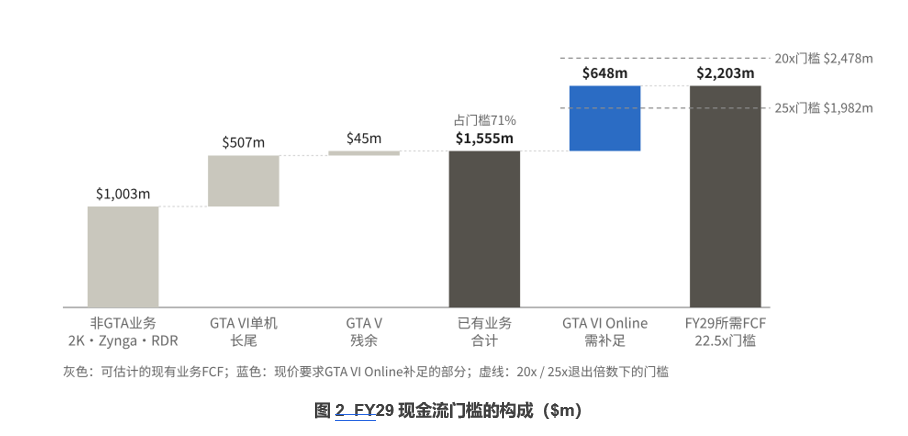
At a 22.5x exit, FY29 requires $2.26bn of FCF. After the existing $1.55bn, GTA VI Online must contribute about $0.70bn of FCF (Figure 2).
Figure 2: Building the FY29 cash flow hurdle ($m)
• Non-GTA business (2K, Zynga, Red Dead): $1,003m
• GTA VI single-player tail: $507m
• GTA V residual: $45m
• Existing businesses, subtotal: $1,555m (69% of the hurdle)
• GTA VI Online, required: $701m
• FY29 FCF hurdle at 22.5x: $2,256m (at 20x: $2,538m; at 25x: $2,031m)
We estimate Online's FCF margin at 38.3%. From Online bookings we deduct content operations, servers and direct costs (about 15%), then Rockstar's 45% share and an 18% tax rate.
Online FCF margin = (1 − 15%) × 55% × (1 − 18%) ≈ 38.3%
GTA VI Online therefore needs about $0.70bn ÷ 38.3% ≈ $1.83bn of bookings, about 3.6 times GTA V Online's roughly $515m in FY26. At 44.5m annual active players that is an ARPU of about $41; at our base of 51m it is about $36.
The company does not disclose GTA Online's active users, so 44.5m is a reference point rather than a reported figure. If GTA VI sells 75–80m units cumulatively by FY29 (GTA V sold about 65m in its first three fiscal years), 44.5m annual players means a little under 60% of buyers log into Online at least once a year. Our base of 51m means about two-thirds do. We expect the higher share because GTA Online has built a large online audience over 13 years, and because Online is where new content will arrive once players finish the story. If Online is also sold separately or at a low price, the player base could even exceed the number of single-player buyers. Because the uncertainty is large, Section 8 tests a range of 30m to 70m.
This is the central result of the memo. At 22.5x EV/FCF and a 10% required return, the current price needs GTA VI Online to reach about 44.5m annual players spending about $41 a year, or 51m spending about $36. Against a GTA+ subscription of $96 a year, that is not a demanding bar. The exit multiple matters a great deal, though: at 20x the same 44.5m players would need $58 of ARPU; at 25x, only $28.
8. Sensitivity Analysis
Players and ARPU substitute for each other. With only 30m stable players the price needs about $61 of ARPU; above 50m players the monetization required is low. The table below shows value today for combinations of the two (22.5x exit, 10% required return, other assumptions unchanged). The current price is $208.82; the five combinations in bold are below it.
Value today by Online player base and ARPU ($ per share):
• 30m players: $187 at ARPU $40; $197 at ARPU $50; $208 at ARPU $60; $213 at ARPU $65; $218 at ARPU $70
• 40m players: $201 at ARPU $40; $215 at ARPU $50; $229 at ARPU $60; $236 at ARPU $65; $242 at ARPU $70
• 44.5m players: $207 at ARPU $40; $223 at ARPU $50; $238 at ARPU $60; $246 at ARPU $65; $253 at ARPU $70
• 51m (base) players: $216 at ARPU $40; $234 at ARPU $50; $251 at ARPU $60; $260 at ARPU $65; $269 at ARPU $70
• 60m players: $229 at ARPU $40; $249 at ARPU $50; $270 at ARPU $60; $281 at ARPU $65; $291 at ARPU $70
• 70m players: $242 at ARPU $40; $267 at ARPU $50; $291 at ARPU $60; $303 at ARPU $65; $315 at ARPU $70
Conversely, the next table shows the ARPU needed to support the current price for different player bases and exit multiples.
ARPU needed to support the current price ($ per player per year):
• 30m: 20x: 85.5; 22.5x (center): 61.0; 25x: 41.3
• 35m: 20x: 73.3; 22.5x (center): 52.3; 25x: 35.4
• 40m: 20x: 64.1; 22.5x (center): 45.7; 25x: 31.0
• 44.5m: 20x: 57.6; 22.5x (center): 41.1; 25x: 27.9
• 51m (base): 20x: 50.3; 22.5x (center): 35.9; 25x: 24.3
• 60m: 20x: 42.7; 22.5x (center): 30.5; 25x: 20.7
• 70m: 20x: 36.6; 22.5x (center): 26.1; 25x: 17.7
Two points follow. First, if Online holds only 30m active players the stock is not cheap: the $61 of ARPU required is at the bottom of our $60–70 range. Second, at a 20x exit even our base of 51m players needs $50 of ARPU, so the exit multiple matters about as much as the player base.
9. Can ARPU Reach $60–70?
We think $60–70 is achievable, though it is not a conservative assumption; the price needs only about $36–41. Our base ARPU of $65 comes from this payer mix:
• Non-paying: Share of players: 51%; Annual spend ($): 0; Contribution to ARPU ($): 0
• Light spenders: Share of players: 22%; Annual spend ($): 30; Contribution to ARPU ($): 6.6
• GTA+ subscribers or core spenders: Share of players: 17%; Annual spend ($): 96; Contribution to ARPU ($): 16.3
• Heavy spenders: Share of players: 8%; Annual spend ($): 300; Contribution to ARPU ($): 24.0
• Whales and creator economy: Share of players: 2%; Annual spend ($): 905; Contribution to ARPU ($): 18.1
• Total: Share of players: 100%; Contribution to ARPU ($): 65.0
The mix has two implications. First, $65 does not require most players to spend $65 a year: about half pay nothing. GTA+ costs $7.99 a month, about $96 a year. Our mix has 49% of players spending something during the year. With 45% paying (20% light spenders and 15% subscribers or core spenders), ARPU would be about $62.5; the difference reflects our view that a larger share of GTA VI players will take up GTA+. Second, ARPU depends heavily on a small group of big spenders: the 10% who are heavy spenders or whales contribute $42.1, about 65% of ARPU. Whether GTA VI Online succeeds therefore depends not only on how many people log in, but on whether Rockstar builds a strong enough system of GTA+, virtual currency, user-created content and regular updates. Rockstar's 2023 acquisition of Cfx.re, the team behind the FiveM role-play server platform, gives it a ready base for a creator economy.
As an external reference, Roblox, the largest user-generated game platform, had 2025 bookings of $6.8bn and an average of 127m daily active users, or about $54 per daily user a year. Our $65 is per annual active player, a larger base than daily users, so it implies stronger monetization per user than Roblox. GTA's audience is mostly adult and it has a subscription product, both of which support higher spending, but the comparison is a reminder that $60–70 is a success-case outcome.
10. Value Triggers: Which Variable Matters Most
In the expectations-investing framework, GTA VI Online falls under the sales value trigger, with stable player numbers and ARPU as the volume and price drivers. The non-GTA FCF margin maps to costs and investment. The FY29 exit multiple is a valuation assumption rather than an operating variable, but we include it. Within the ranges we set, the stable player base has the largest effect on value, followed by the exit multiple, the non-GTA FCF margin and ARPU, which are close to one another. GTA V Online cannibalization and GTA VI's launch unit sales have the smallest effect (Figure 3).
Figure 3: One-variable sensitivity: value today at the low and high setting of each variable
Base case value $260; current price $208.82. Value today at the low and high setting of each variable:
• Stable Online players (35m / 65m): $224 to $292, a range of $68
• FY29 exit multiple (20x / 25x): $232 to $289, a range of $57
• Non-GTA FCF margin (12% / 22%): $234 to $287, a range of $53
• Online ARPU ($50 / $80): $234 to $287, a range of $53
• FY29 single-player units (10m / 20m): $244 to $274, a range of $30
• GTA V Online cannibalization (100% / 60%): $257 to $264, a range of $7
• GTA VI launch units, FY27–FY28 (45m / 75m): $258 to $262, a range of $4
Players and ARPU are mathematically symmetric. Online bookings are their product, so a 10% increase in either adds the same amount, about $11.5 per share. Players rank first in the chart only because we give them a wider range. The company does not disclose active users and GTA VI Online has not launched, so a steady state of 35m or 65m is plausible, whereas ARPU at least has GTA+ pricing as an anchor for core payers.
Launch units sit at the bottom of the chart. Selling 45m or 75m units over FY27–FY28 moves value by only about $4 per share, because launch cash is counted once rather than capitalized (Section 4.2). The variable that dominates public discussion of GTA VI has the least effect on what the company is worth.
Required ARPU tells the same story (22.5x, 44.5m players):
• Non-GTA FCF margin: Setting: 12%; ARPU needed to support the price ($): 58.4
• Non-GTA FCF margin: Setting: 15%; ARPU needed to support the price ($): 48.0
• Non-GTA FCF margin: Setting: 17% (base); ARPU needed to support the price ($): 41.1
• Non-GTA FCF margin: Setting: 20%; ARPU needed to support the price ($): 30.7
• Non-GTA FCF margin: Setting: 22%; ARPU needed to support the price ($): 23.8
• FY29 GTA VI single-player units: Setting: 10m; ARPU needed to support the price ($): 51.6
• FY29 GTA VI single-player units: Setting: 20m; ARPU needed to support the price ($): 32.5
• GTA V Online cannibalization: Setting: 60%; ARPU needed to support the price ($): 38.8
• GTA V Online cannibalization: Setting: 100%; ARPU needed to support the price ($): 43.4
Cutting the non-GTA FCF margin from 17% to 12% raises the required ARPU from $41 to $58, the same effect as cutting stable players from 44.5m to about 31m, yet this variable rarely comes up in discussions of GTA VI. Cannibalization has to be handled conceptually but barely affects value: even if GTA V Online were replaced entirely, the required ARPU would rise only from $41 to $43, because GTA V Online was about $515m in FY26 while GTA VI Online is $3.3bn in our base case. The single-player tail matters somewhat: at 10m FY29 units the required ARPU rises to $52, and at 20m it falls to $33. Around our base case, each additional 5m stable players adds about $11 per share, each additional $5 of ARPU about $9, and each point of non-GTA FCF margin about $5.
Our ranking is: stable player numbers matter most, followed by the exit multiple, the non-GTA FCF margin and ARPU, then the single-player tail, GTA V cannibalization and launch sales. A view on stable players is worth far more than a view on launch sales.
11. Where the Model Is Optimistic
Our base player and ARPU assumptions look moderate against the hurdle, but in cash flow terms they sit at the optimistic end, and we do not treat $2.83bn of FY29 FCF as a conservative case. There are four reasons:
1. The company-wide FCF margin is high. Base FY29 FCF is $2.83bn on $10.24bn of bookings, a 27.6% margin. Consensus is about 21% ($1.99bn / $9.46bn), Capcom about 24% and EA about 29% in FY26. We are in effect assuming that within three years Take-Two goes from weak cash conversion to a margin close to EA's.
2. Development of the next major game is not charged separately. By FY29 GTA VI's development cost is sunk, but Rockstar will certainly be developing its next project, and capitalized development spending runs through operating cash flow. The model requires the 17% non-GTA margin to absorb it; charged separately, FY29 FCF would be lower.
3. The external reference for ARPU is demanding. $65 per annual player is already above Roblox's roughly $54 per daily user.
4. GTA VI Online's timing is unconfirmed. We assume FY29 is a full year of operation, which requires multiplayer to launch during 2027. If it slips beyond that, the steady-state year moves out and the time value of money lowers value today.
If the non-GTA FCF margin falls to 12–15% (value $234–250), or stable Online players are only 30–35m (value $213–224), the expected return falls from about 20% a year to roughly 11–18%. That is still above our 10% hurdle, but with a much thinner margin of safety.
12. Industry Landscape
The games industry is polarizing. AI and mature tools have sharply cut the cost of producing content, and small teams can make a game of the year on a fraction of a blockbuster budget. Meanwhile the cost and development time of AAA games keep rising, which pushes large publishers toward more predictable recurring revenue. In our view, Take-Two's moat is not that it can make good games but that it owns a few virtual worlds that can be run and monetized for many years.
12.1 AI lowers the barrier for small teams
Use of generative AI in game development is spreading quickly. Steam games disclosing generative AI use were about a fifth of new releases in 2025 and close to a third by mid-2026. GDC's 2026 industry survey found that 36% of developers use generative AI at work, but 52% think it is harmful to the industry.
Small-team games are also challenging the majors. Clair Obscur: Expedition 33 was made by a team of about 30 on a budget its CEO put below $10m; it sold more than 8m copies and won Game of the Year at The Game Awards 2025. Balatro, from a solo developer, sold more than 5m copies, and Palworld reached 32m players within a year. By contrast, leaked Insomniac documents put the cost of Marvel's Spider-Man 2 at about $315m, Sony court filings put The Last of Us Part II at about $220m over more than five years of development, and Xbox's Matt Booty has said AAA development cycles have stretched from 2–3 years to 4–6. On January 29, 2026, Google launched Project Genie, which generates interactive scenes from text, and game stocks fell broadly the next day.
Our view is that AI lowers the barrier to producing content, not the barrier to keeping tens of millions of people in the same world for years. The more content there is, the more players' time concentrates in existing large online games: Newzoo data show that new releases accounted for only about 12–13% of PC and console playtime in 2025. AI therefore cuts both ways for Take-Two. It erodes the scarcity of one-off single-player blockbusters but raises the relative value of long-running virtual worlds, and it can also lower Rockstar's own cost of producing updates, NPCs and missions.
12.2 AAA cost pressure and recurring revenue
AAA games need budgets of $200–300m or more and five or more years of development, while revenue is concentrated in the first year or two after release, so a single failure can wipe out years of profit. That is why the industry has moved toward in-game spending: recurring revenue is more predictable and extends each game's life. RCS was 78% of Take-Two's FY26 net bookings (82% in Q4), live services were about 71% of EA's FY26 net revenue, and Newzoo estimates that microtransactions were 48% of PC game revenue in 2025.
But live service is a winner-take-all business. Sony's Concord launched on August 23, 2024 and was withdrawn, with refunds, on September 6. Warner Bros. Discovery took an impairment of about $200m on Suicide Squad: Kill the Justice League. Sony took a ¥31.5bn impairment on Bungie in November 2025 because of Destiny 2's performance. Highguard launched in January 2026 and shut down in March. Recurring revenue means predictable cash flow only for the few platforms that have proven themselves. GTA Online, in its 13th year, is one of them, which is why we center the valuation on GTA VI Online rather than on launch sales.
12.3 Mobile: why Zynga did not become another King
On January 10, 2022, Take-Two agreed to buy Zynga for an enterprise value of about $12.7bn, or $9.86 per share ($3.50 in cash and $6.36 in TTWO stock), a 64% premium to the prior close. The deal closed on May 23, 2022. Management aimed to lead in mobile and bring Take-Two's IP to new cross-platform experiences, in essence repeating Activision Blizzard's 2016 purchase of King.
• Announced / closed: Activision Blizzard buys King: November 2015 / February 2016; Take-Two buys Zynga: January 2022 / May 2022
• Deal value: Activision Blizzard buys King: Equity about $5.9bn, about 6.4x EBITDA, 20% premium; Take-Two buys Zynga: Enterprise value about $12.7bn, 64% premium, mostly paid in stock
• Core asset: Activision Blizzard buys King: One super-IP: Candy Crush, more than $20bn of lifetime revenue; Take-Two buys Zynga: A spread portfolio of casual, hyper-casual and social games
• After the deal: Activision Blizzard buys King: King segment operating income of $0.74–1.14bn a year in 2018–2022; Take-Two buys Zynga: About $5.9bn of goodwill impairments in FY24–FY25 (reporting unit not disclosed)
• Cross-platform result: Activision Blizzard buys King: Call of Duty: Mobile passed 100m downloads in its first week; Take-Two buys Zynga: Star Wars: Hunters shut down about 16 months after launch
• Outcome: Activision Blizzard buys King: Microsoft bought Activision Blizzard for $68.7bn in 2023, calling mobile the largest segment of gaming; Take-Two buys Zynga: Mobile became a steady source of cash but not a cross-platform engine
Sources: King acquisition announcement, Activision Blizzard segment data, Take-Two FY24 and FY25 earnings releases, Microsoft announcement, Gematsu. The two impairments were $2.34bn in FY24 and $3.55bn in FY25, together similar to the roughly $6.2bn of goodwill recognized on the Zynga acquisition.
We see four reasons why Zynga did not become another King. First, Take-Two bought at the top of the cycle. The deal was announced at the post-pandemic peak in mobile gaming, after Apple's App Tracking Transparency, introduced in April 2021, had already weakened ad targeting and user acquisition; Zynga warned of the impact in the second half of 2021 and its shares fell about 30% in three months. Mobile growth then stalled. Sensor Tower puts global app store spending on mobile games at $81.8bn in 2025, only slightly above $76.7bn in 2023 and now below non-game apps ($85.6bn). Second, Take-Two bought a portfolio rather than a super-IP. King's value was concentrated in one evergreen product, Candy Crush, whereas Zynga was a collection of mid-sized titles plus a hyper-casual business. Hyper-casual games depend on advertising, were hit hardest by ATT, and were later scaled back by management. Third, the IP never crossed platforms. Activision worked with Tencent's TiMi studio to turn Call of Duty into a mobile hit, while Take-Two produced nothing of similar scale for GTA or NBA 2K on mobile, and Zynga's move the other way, Star Wars: Hunters on console and PC, has shut down. Fourth, the price was high. King cost about 6.4x EBITDA with a 20% premium; Zynga carried a 64% premium, mostly paid in stock, which diluted TTWO shareholders.
Zynga is not without value. FY26 mobile net bookings were $3.30bn, up about 15%, led by Match Factory!, Toon Blast, Toy Blast, Empires & Puzzles and Color Block Jam. The April 30, 2025 injunction in Epic v. Apple allowed US apps to steer users to outside payment options, and Take-Two says its direct-to-consumer business set records, which helps mobile margins; but the US Supreme Court has agreed to hear Apple's appeal, so the outcome is uncertain. For our model, Zynga is about half of non-GTA bookings, and its cash conversion largely decides whether the 17% non-GTA margin holds. It is a source of cash, not a growth engine.
12.4 Bull case: from a game to a virtual world
The most attractive outcome for Take-Two is GTA VI becoming a metaverse-like virtual world: technology makes the game more immersive, players socialize, create and role-play inside it, time spent rises, and in-game spending rises with it. There are precedents. Roblox paid creators $1.50bn in 2025 ($0.92bn in 2024), and Epic has paid Fortnite creators more than $1bn since 2023. Rockstar acquired Cfx.re in August 2023, and there have been reports, not confirmed by the company, that Rockstar approached Roblox and Fortnite creators about user-generated content for GTA VI. AI is also a tool for operators of existing large worlds: more lifelike NPCs and faster content updates can make players stay longer.
In our model, if GTA VI Online reaches 60–70m players in its steady state at $70 of ARPU, Take-Two is worth about $291–315 per share today at a 22.5x exit and a 10% required return, 39–51% above the current price.
Whether this happens depends on two things, IP and talent. On IP, the GTA franchise has shipped more than 465m units and Red Dead Redemption 2 more than 85m; a brand and user base of that size cannot be copied quickly by AI tools or new entrants. On talent, Rockstar's core creative team is irreplaceable, and Take-Two's annual report lists the loss of key creative staff as a risk. Co-founder Dan Houser left in March 2020, and former GTA producer Leslie Benzies sued the company after leaving in 2016, seeking about $150m in royalties. The profit-sharing arrangement tied to GTA (the 45% in our model) is both how Take-Two keeps its talent and the largest discount to shareholder profit. Section 13 covers the related risks.
13. Investment Risks
The biggest risk is not that GTA VI fails to sell but that launch quality or the Online experience disappoints and the steady-state player base falls short. The table maps the main risks to model variables. The value effect is value today with other assumptions at base (price $208.82, base $260); likelihood is our judgment.
• Launch quality problems: Likelihood: Low; Variables affected: Stable players, ARPU; Value effect: 30m players × $50: about $197; Main mitigants: Current-generation consoles only; two delays; public gameplay demo
• GTA VI Online delayed or poorly received: Likelihood: Medium; Variables affected: Steady-state year moves out; stable players; Value effect: One-year delay: about $237; 30m players: about $213; Main mitigants: 13 years of running GTA Online; single-player first
• Hardware barrier: Likelihood: Medium; Variables affected: FY29 single-player units, stable players; Value effect: Moderate: about $241; severe: about $224; Main mitigants: Installed base similar to GTA V's launch; GTA VI drives console sales
• Non-GTA decline or weak cash conversion: Likelihood: Medium; Variables affected: Non-GTA bookings, FCF margin; Value effect: Bookings stay at FY27 level: about $252; 12% margin: about $234; Main mitigants: NBA 2K growth; 22 releases in FY28–FY29; mobile direct sales
• AI lowers industry multiples: Likelihood: Medium; Variables affected: Exit multiple; Value effect: 20x: about $232; Main mitigants: Large virtual worlds and IP are hard to copy
• Regulation of in-game spending: Likelihood: Medium-low; Variables affected: ARPU; Value effect: ARPU $50: about $234; Main mitigants: GTA is rated 18+
• Talent loss and labor disputes: Likelihood: Medium-low; Variables affected: Long-term players, ARPU and multiple; Value effect: Hard to quantify separately; Main mitigants: Profit-linked pay pools
• Leaks and piracy: Likelihood: Low; Variables affected: Launch sales, marketing timing; Value effect: Limited effect on FY29; Main mitigants: Console first, PC later
13.1 Launch quality: the lesson of Cyberpunk 2077
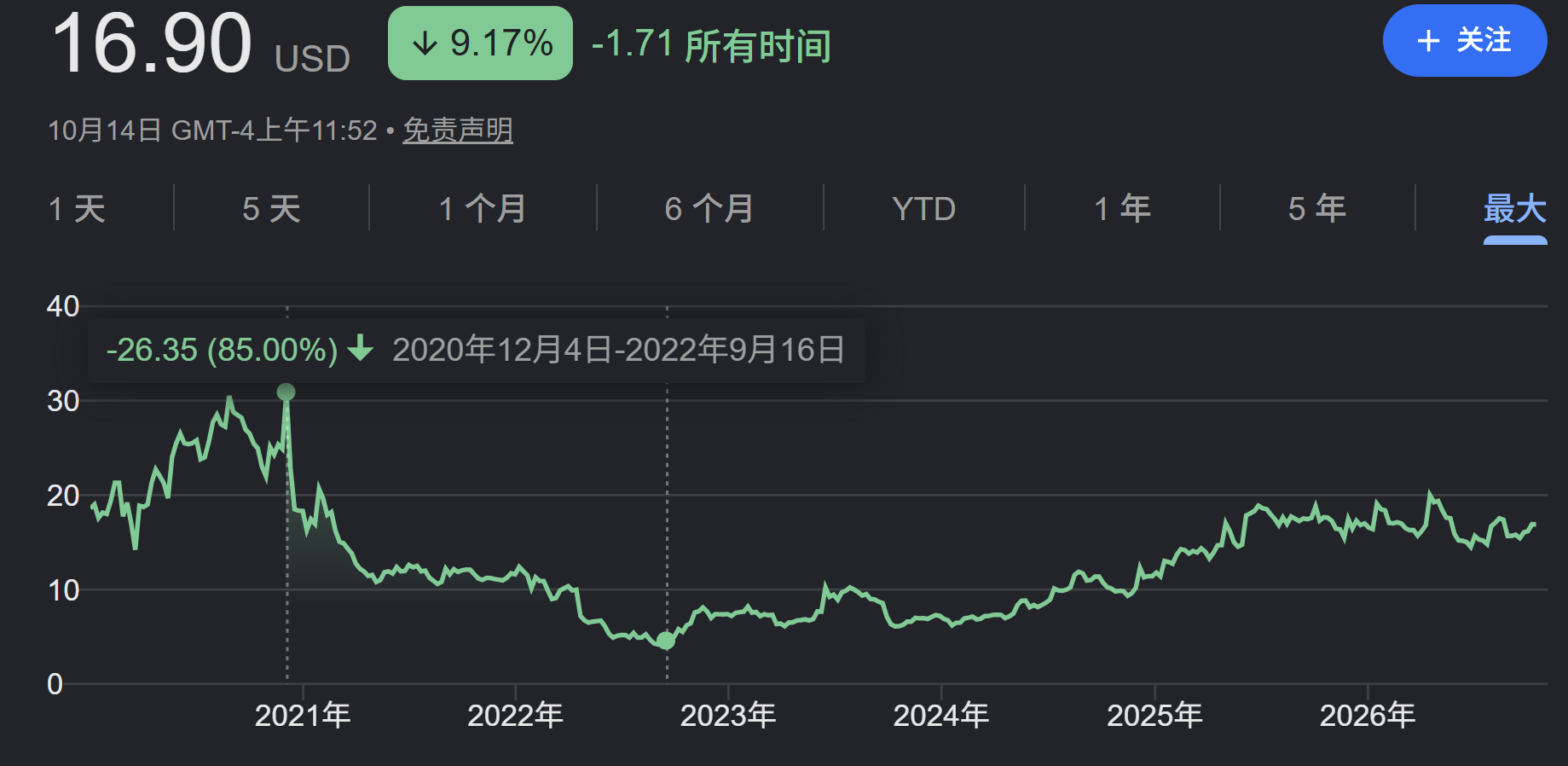
CD Projekt released Cyberpunk 2077 on December 10, 2020. The PS4 and Xbox One versions had serious problems, and the Metacritic user score fell as low as 2.8 out of 10. CD Projekt apologized and offered refunds on December 14; Sony pulled the game from the PlayStation Store on December 17 and did not restore it until June 21, 2021. CD Projekt's market value fell from more than PLN 40bn before the launch to under PLN 10bn by July 2022, a drop of more than 75% in about 19 months, and the company paid $1.85m to settle a US class action. It then rebuilt the game's reputation step by step through patches, the Netflix anime Edgerunners (September 2022) and the Phantom Liberty expansion (September 2023), and the game had sold more than 35m copies by November 2025.
We take three lessons from it. First, pre-orders and brand strength cannot make up for a bad launch, and for a company whose value is concentrated in one product, the damage to valuation is far larger than the lost sales. Second, Cyberpunk's problems were mainly on last-generation consoles; GTA VI launches only on PS5 and Xbox Series and avoids that risk. Third, a reputation can be repaired, but it takes two to three years. For our FY29 steady-state year, the main damage would be to player retention and Online engagement, not to launch sales.
Rockstar has delayed GTA VI twice (first planned for 2025, then May 2026, now November 2026), which shows it is willing to trade time for quality, and the gameplay demo shown on August 27, 2026 indicates the game is in a playable state. GTA V and Red Dead Redemption 2 both launched far more cleanly than the industry average.
13.2 GTA VI Online: the uncertainty of a new system
GTA VI's online mode has not been formally announced, and its business model (whether it is sold separately, whether it is free, how GTA+ carries over) is unknown. Possible problems include server and data failures at launch, an unbalanced virtual economy or monetization design, cheating and money exploits, and the pace at which players migrate from GTA V Online.
Rockstar's own history shows these risks are real. For the first few days after its October 1, 2013 launch, GTA Online was barely playable; some players permanently lost characters and progress, and Rockstar gave that month's players GTA$500,000 in compensation. Red Dead Online never matched GTA Online's success, and in July 2022 Rockstar said it would stop major updates and move resources to GTA VI.
The mitigants are just as clear. GTA Online grew from a poor start into a platform now in its 13th year that still produced about $515m of bookings in FY26, and Rockstar has built a full operating system for servers, the virtual economy, anti-cheat, content cadence and the GTA+ subscription. Launching GTA VI as a single-player game first, with Online expected in 2027, also gives the team time to stabilize servers and tune the economy. Most of the live-service failures in Section 12 were new IPs without an existing player base; GTA VI Online has ready-made demand.
Effect on the model: if Online slips beyond FY29, FY29 is no longer the steady-state year. Moving the steady state out by one year lowers base value from about $260 to about $237. If Online launches but holds only 30m stable players, base value falls to about $213.
13.3 Hardware barrier
Our conclusion is that hardware will not materially limit GTA VI's launch sales, but it will meaningfully limit the single-player tail and the Online player ceiling in FY28–FY29, the years our valuation rests on. Most first-year buyers already own a console. The problem is that consoles and PCs are getting more expensive late in the cycle, so new players will arrive more slowly, and the FY29 tail and steady-state player base depend on exactly those new players. The effect on Online spending is fewer players rather than lower spending per player. By our estimates, a moderate effect lowers value from about $260 to about $241 (−7%) and a severe one to about $224 (−14%). Both remain above the current price, but much of the margin of safety is gone. This is a material but not fatal risk; it threatens the thesis only in combination with a delayed or poorly received Online launch.
The available data show the barrier rising:
• Current-generation consoles. PS5 had shipped 95.3m units by June 2026. Microsoft does not disclose Xbox Series X|S sales; independent estimates are about 30–37m, for a combined base of about 125–130m. For comparison, Take-Two estimated the console installed base at GTA V's 2013 launch at more than 120m. PS4 (about 117m units) and Xbox One owners cannot play GTA VI.
• Console prices. Prices for this generation are rising late in the cycle instead of falling. PS5 went to $649.99 from April 2026 and PS5 Pro is $899.99; Xbox Series X went to $799.99 from August 2026, and Microsoft says console storage and memory costs have risen more than 2.5 times and expects them to double again by autumn 2027. Nintendo has also raised the Switch 2 price, citing memory costs. Circana data show US Xbox hardware unit sales down 33% in the first eight months of 2026 and PlayStation down 25%; August hardware sales were the lowest since 2013. PS5 shipped 1.6m units in April to June 2026, down 36%.
• PC. TrendForce data show conventional DRAM contract prices up 93–98% quarter on quarter in Q1 2026, with a further 58–63% expected in Q2, as AI server demand absorbs capacity. In the US, 32GB of DDR5 memory has gone from $100–200 in October 2025 to more than $350, and the median price of an RTX 5070 graphics card is about $900, 64% above the suggested retail price. The graphics card and memory alone now cost more than $1,200.
• Cloud gaming. GeForce NOW's paid tiers cost about $10–20 a month and have a 100-hour monthly cap from 2026. Game Pass Ultimate has risen to $29.99 a month and will limit cloud play to 15 hours a month from November 2026. PS Plus Premium costs $19.99 a month and streams only to PS5 or PlayStation Portal. Cloud latency is about 37–40ms versus about 8–16ms for local play, and more than 70ms on poor connections. It has not been confirmed whether GTA VI will be on cloud platforms at launch, and Xbox has said it will not stream to PC.
Effect on single-player sales. The effect in the launch year is limited, because the current-generation installed base is similar to GTA V's at launch and most launch buyers already own a console. The effect falls on the tail. In a normal console cycle, late-cycle price cuts keep bringing in new users; in this cycle consoles are getting more expensive and shipments are falling, so FY28–FY29 may bring fewer new users than usual, which would pull FY29 single-player units below our 15.5m. Sony's CEO has said the timing and price of the next console are undecided and expects memory prices to stay high in FY2027. A PC version is the main support for the tail, but the cost of a new gaming PC has risen sharply. Existing PC owners are reasonably well equipped: Steam's September 2026 survey shows about half of users with 12GB or more of graphics memory, and more users now have 32GB of RAM than 16GB. Rockstar's PC ports have also tended to run on modest hardware; the 2015 PC version of GTA V needed only 4GB of RAM and a graphics card with 1GB of memory. GTA VI itself will drive console sales, as Take-Two's CFO has said he expects, but Ampere Analysis believes PS5 prices are already above the ideal level for GTA VI's launch.
Effect on Online spending. Player numbers are hit first. Our base of 51m annual players is about 40% of the current-generation installed base, and slower growth in that base lowers the ceiling; the social nature of Online amplifies the effect. ARPU is less affected and could even be higher. Players who can afford a $650–800 console or a high-end PC are more willing to spend, and about two-thirds of our ARPU comes from the 10% of players who are heavy spenders or whales, most of whom will keep local hardware. Cloud gaming will attract mainly light players: monthly hour caps, extra subscription fees and latency do not suit core users who play dozens of hours a month, and those are the main spenders. Players left on PS4 and Xbox One cannot migrate, so GTA V Online cannibalization may be below 80% and the old Online would keep more revenue, but this effect is small.
Hardware barrier scenarios (22.5x exit, 10% required return, other assumptions unchanged):
• Base: FY29 single-player units: 15.5m; Stable players: 51m; ARPU: $65; Share of GTA V Online replaced: 80%; FY29 FCF: $2.83bn; Value today: $260; Annual return: 20.1%
• Hardware barrier (moderate): FY29 single-player units: 12m; Stable players: 44.5m; ARPU: $67.5; Share of GTA V Online replaced: 70%; FY29 FCF: $2.61bn; Value today: $241; Annual return: 16.5%
• Hardware barrier (severe): FY29 single-player units: 10m; Stable players: 41.5m; ARPU: $65; Share of GTA V Online replaced: 70%; FY29 FCF: $2.43bn; Value today: $224; Annual return: 13.2%
The moderate case assumes about 3.5m fewer FY29 single-player units and about 6.5m fewer stable players, with slightly higher spending per player and more revenue kept by the old Online; value is about $241, about 16.5% a year to FY29. In the severe case value is about $224, about 13% a year, still above our 10% requirement. Signals to watch include quarterly PS5 and Xbox shipments and US hardware sales, console and memory prices, the hardware requirements when the GTA VI PC version is announced, whether GTA VI comes to cloud platforms, and whether console sales recover after GTA VI's release.
13.4 Other risks
• Leaks and security. On September 18, 2022, a hacker leaked 90 videos of GTA VI in development. TTWO fell as much as 5.8% in pre-market trading the next day, and Rockstar told a court that recovery cost about $5m. Leaks remain possible around launch, and the PC version will face piracy.
• Talent and labor relations. Around October 30, 2025, Rockstar dismissed 34 employees in the UK and Canada. The IWGB union accuses it of union-busting; Rockstar and Take-Two say the staff leaked confidential information in a forum that included outsiders. The final employment tribunal hearing began in Glasgow on September 10, 2026 and was expected to end in mid-October; there is no ruling yet. The dispute affects hiring, morale and reputation.
• Regulation. The EU Consumer Protection Cooperation network published principles on in-game virtual currencies in March 2025 and took coordinated action against nine game companies on September 30, 2026. Take-Two was not among them, but mobile publishers such as King and Supercell were. A proposed Digital Fairness Act is tentatively due in November 2026. Brazil has banned loot boxes in games accessible to minors since March 2026, and in the US the FTC reached a $520m settlement with Epic over "dark patterns" and related issues. GTA's monetization, which relies mainly on virtual currency (Shark Cards), would be affected by price transparency rules, and Zynga's mobile games are more directly exposed to rules on minors.
• AI and valuation multiples. TTWO's sharp fall the day after Project Genie's release shows the market will put lower multiples on game companies over AI concerns. If the FY29 exit multiple were only 20x, base value would fall from about $260 to about $232.
• Non-GTA business and dilution. See Sections 6, 10 and 4.2.
14. Scenario Valuation
All scenarios use a 22.5x FY29 EV/FCF except the downside, which uses 20x. All assume 80% GTA V Online cannibalization and include the Section 4.2 bridge (launch cash of $1.96bn, net debt of $0.69bn and 5% dilution). Value today is FY29 enterprise value plus net cash, adjusted for dilution, discounted at 10% for 2.5 years and divided by about 187m shares. The annual return is the return from buying at $208.82 and exiting at the scenario's FY29 value.
• Downside: Online players: 30m; ARPU: $40; Non-GTA FCF margin: 12%; FY29 single-player units: 10m; Exit multiple: 20x; FY29 FCF: $1.54bn; Value today: $129; vs. price: −38%; Annual return: −9.4%
• Conservative: Online players: 35m; ARPU: $50; Non-GTA FCF margin: 15%; FY29 single-player units: 15.5m; Exit multiple: 22.5x; FY29 FCF: $2.11bn; Value today: $195; vs. price: −6%; Annual return: 7.1%
• Cautious: Online players: 38m; ARPU: $60; Non-GTA FCF margin: 17%; FY29 single-player units: 15.5m; Exit multiple: 22.5x; FY29 FCF: $2.43bn; Value today: $224; vs. price: +7%; Annual return: 13.2%
• Reference: Online players: 44.5m; ARPU: $62.5; Non-GTA FCF margin: 17%; FY29 single-player units: 15.5m; Exit multiple: 22.5x; FY29 FCF: $2.62bn; Value today: $242; vs. price: +16%; Annual return: 16.6%
• Base: Online players: 51m; ARPU: $65; Non-GTA FCF margin: 17%; FY29 single-player units: 15.5m; Exit multiple: 22.5x; FY29 FCF: $2.83bn; Value today: $260; vs. price: +25%; Annual return: 20.1%
• Bull: Online players: 60m; ARPU: $70; Non-GTA FCF margin: 17%; FY29 single-player units: 15.5m; Exit multiple: 22.5x; FY29 FCF: $3.17bn; Value today: $291; vs. price: +39%; Annual return: 25.6%
Outside the conservative and downside cases, buying at today's price and holding to FY29 returns more than 10% a year. The base case returns about 20%, and our base range of 49–53m players and $60–70 of ARPU gives $247–274, or about 18–23% a year. The reference case, which uses the 44.5m players behind the price-implied hurdle and $62.5 of ARPU, still returns about 17%. Measured from the base case, the distribution is skewed to the downside: the bull case adds about 12% to base value, while the downside case, in which Online monetization, the non-GTA margin, the single-player tail and the exit multiple all go wrong together, takes about half of it away and sits about 38% below the current price. The current price offers reasonable upside rather than a large margin of safety. The conservative case is worth about $195; below that level (the 52-week low is $187.63), even the conservative case would return about 10% a year.
15. Investment View
Take-Two is not a story of the market ignoring GTA VI. A 10% return at today's price needs FY29 FCF about 14% above consensus, so the market has already priced in a successful launch and meaningful Online growth. But the price asks only for about 44.5m Online players spending about $41 a year; it does not price in a very optimistic long-term outcome.
At a 22.5x mature multiple, if Take-Two sustains at least about 40m GTA VI Online players, ARPU above $55 and a non-GTA FCF margin of 15–17%, the price is supported, meaning a return of at least about 10% a year, and the upside grows as results move toward our base case. We expect more than that: 49–53m players, because a larger share of buyers will move into Online, and $60–70 of ARPU, because a larger share of them will pay. The most attractive outcome is not 50m or 60m launch units but GTA VI becoming a platform that runs for more than a decade, with 50m or more stable players and ARPU above $60. In that case FY29 FCF is about $2.7bn or more and today's price looks cheap.
Our conclusion: we are positive on Take-Two. The valuation is not demanding, launch sales alone do not make the stock undervalued, and the case rests on GTA VI Online becoming a long-term platform. At today's price the base case returns about 20% a year, which suits a medium- to long-term position built on that thesis. The margin of safety is not large enough to ignore the risks of a delayed Online launch, the hardware barrier and weak non-GTA cash conversion, so position size should allow for the downside case. A price below about $195 would be a more attractive point to add.
We would raise our expectations if GTA VI Online launches within FY28 (before March 2028) and early engagement suggests a steady state above 53m players; if GTA+ prices rise or its benefits expand, the creator economy opens up, and RCS grows clearly faster than single-player sales decline; or if the non-GTA business shows cash conversion at or above 17% in FY28, or FY28–FY29 releases beat expectations.
We would lower them if GTA VI Online slips beyond FY29 or loses players quickly after launch; if Zynga or NBA 2K declines and the company's FCF margin stays below 20%; if console prices keep rising and hardware sales keep falling; or if mature multiples for game companies fall below 20x.
16. Indicators to Track and Catalysts
Once GTA VI is out, launch sales will quickly lose importance. The three indicators to track are Online active players, recurring ARPU and the company-wide FCF margin.
• GTA VI Online annual active players: Why it matters: The main value trigger; Hurdle at today's price: 44.5m needs $41 of ARPU; 30m needs $61; Our base: 51m (range 49–53m)
• Online recurring ARPU: Why it matters: Sets the size of Online bookings; Hurdle at today's price: $41 at 44.5m players; $36 at 51m; Our base: $65 (range $60–70)
• Company FCF margin: Why it matters: Shows non-GTA cash conversion; Hurdle at today's price: FY29 FCF about $2.26bn (margin about 26%); Our base: FY29 FCF $2.83bn (margin about 28%)
• Non-GTA bookings: Why it matters: Largest block of the hurdle; Hurdle at today's price: FY27 guidance about $5.35bn; Our base: FY29 $5.90bn
• GTA VI annual single-player units: Why it matters: Tail cash flow; Our base: FY29 about 15.5m
Take-Two does not disclose GTA Online's active users or GTA's recurring revenue separately. We can only infer them from GTA's share of revenue in the annual report, RCS growth and management commentary. The main catalysts over the next year are:
1. November 19, 2026: GTA VI launches on consoles.
2. Q3 and Q4 FY27 results: launch sales, and whether the company raises FY27 guidance.
3. During 2027: the announcement and launch of GTA VI's multiplayer and its business model (sold separately or not, GTA+ benefits).
4. Around May 2027: FY27 results and FY28 guidance, the first guidance to include a full year of GTA VI.
5. Announcement of the GTA VI PC version: it sets the FY28–FY29 single-player tail and reveals the PC hardware requirements.
6. 2K release dates: timing for the next BioShock, Judas and the new IPs.
Appendix A: Key Assumptions
• Share price / market cap: Value: $208.82 / $39.05bn (about 187m shares); Basis: Close, October 12, 2026
• Required return: Value: 10% a year; Basis: Our equity hurdle
• Holding period: Value: About 2.5 years; Basis: October 2026 to end of FY29 (March 2029)
• FY29 EV/FCF: Value: 20x / 22.5x / 25x; Basis: EA buyout about 24x EV/FCF; mature peers about 24–25x earnings
• Dilution to FY29: Value: About 5%; Basis: FY27 diluted share guidance about 2% above FY26
• Net debt: Value: $0.69bn; Basis: June 30, 2026
• GTA VI launch cash (FY27–FY28): Value: $1.96bn (range $1.5–2.5bn); Basis: 60m units × $61 net; net income $0.89bn plus $1.07bn of non-cash amortization
• Non-GTA bookings: Value: $5.90bn; Basis: Back to the FY26 level; FY27 guidance about $5.35bn, then about 5% a year
• Non-GTA FCF margin: Value: 17%; Basis: Low end of the range from Nintendo (about 17%) to Capcom (about 24%)
• FY29 GTA VI single-player units: Value: 15.5m; Basis: GTA V third fiscal year about 13m (including PC launch), plus about 20%
• Single-player net ASP: Value: $58.8; Basis: 6:4 standard/Ultimate mix, net of fees and discounts
• Single-player FCF margin: Value: 55.6%; Basis: After costs, 45% Rockstar share and 18% tax; non-cash amortization added back
• FY26 GTA V Online bookings: Value: About $515m; Basis: GTA products 12.4% of FY26 revenue, less GTA V single-player
• GTA V Online cannibalization: Value: 80%; Basis: Old Online keeps running; 100% not assumed
• Online FCF margin: Value: 38.3%; Basis: 85% × 55% × 82%
• FY29 Online annual players: Value: 51m (range 49–53m; sensitivity 30–70m); Basis: About two-thirds of 75–80m cumulative buyers; 44.5m used as the reference point
• Base ARPU: Value: $65 (range $60–70); Basis: Payer-mix build (Section 9)
