
I’ve been noticing something lately: the relationship between Netflix (NFLX) and YouTube/TikTok looks a lot like the relationship between DraftKings (DKNG) and Polymarket/Kalshi.
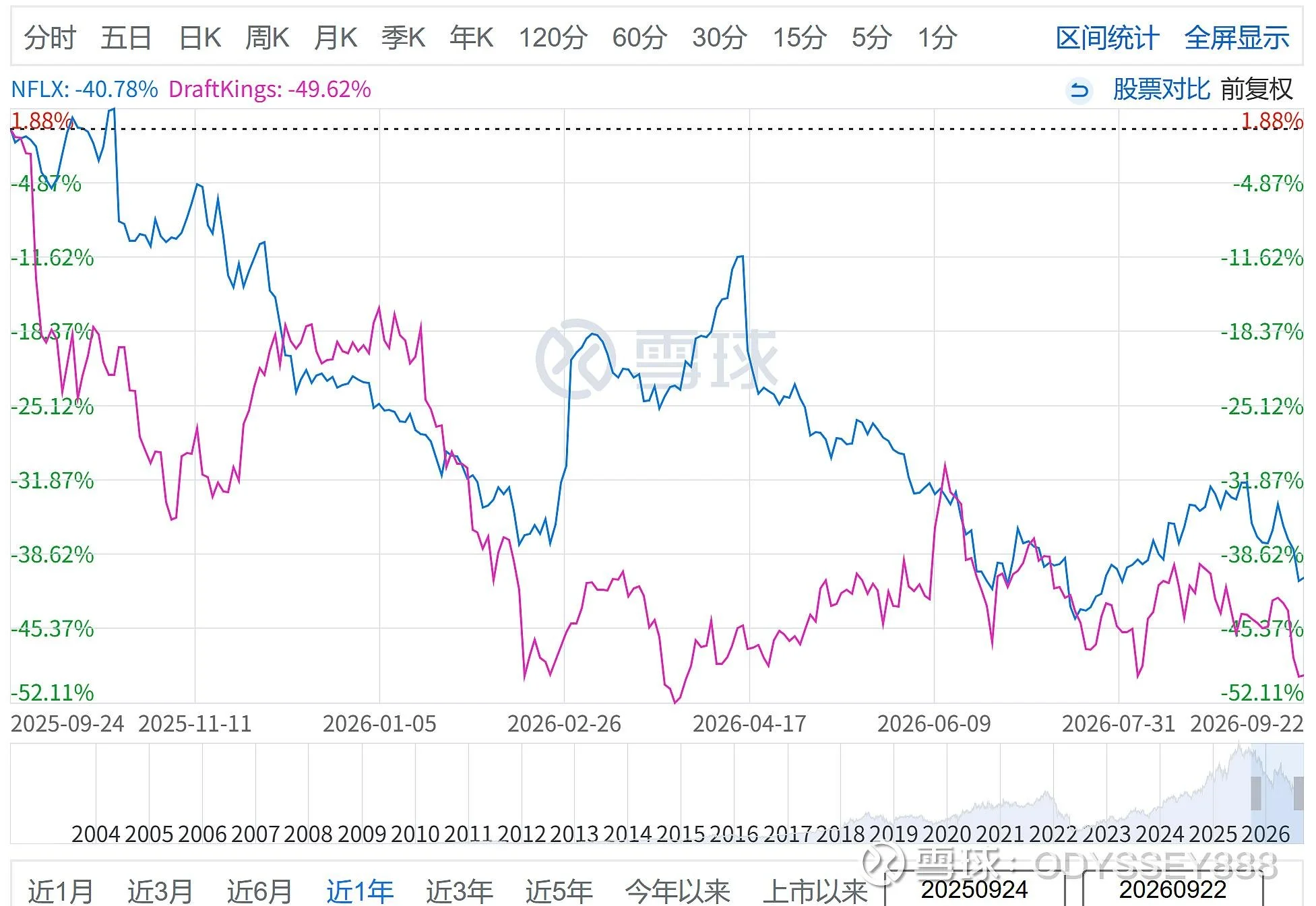
The House vs. the Market
DraftKings and FanDuel are the house. They set their own odds and carry their own risk. Every betting line has to be built by their own traders and risk team, so it’s expensive and slow to scale, and the number of lines they can offer is always limited.
Polymarket and Kalshi are markets. They don’t set odds; they only match buyers and sellers, and prices come from the participants’ own trading. Anyone can propose a new event or a new contract. Innovation is free, supply is self-generating, and it grows exponentially as more participants join.
Apply this framework to video, and Netflix is the house while YouTube and TikTok are the market.
Netflix produces its own content and decides what to fund, how much to spend, and what to charge. Those are the “odds” it sets. It spends nearly $20 billion a year on content, and every show is a bet. The time from greenlight to release is measured in years, and capacity has a hard ceiling: there are only so many titles it can make in a year.
YouTube and TikTok don’t produce content. They provide only the platform and a revenue-sharing mechanism, and creators bring their own content. The platform pays no upfront cost for that content. Innovation happens on its own across tens of millions of creators, and supply grows without limit as the number of creators rises and tools improve. The house model’s marginal cost is rigid; the market model’s marginal cost approaches zero.
The Data Already Tells the Story
Nielsen’s The Gauge shows that in April 2026, YouTube accounted for 13.4% of total TV viewing time in the US. That makes it the largest single media outlet on American TV, ahead of any cable or broadcast network. Netflix came second at 7.8%, and no one else cleared 5%. The direction is clear too: in June 2026, YouTube’s share was up 1.0 percentage point year over year, while Netflix’s was down 0.4 points.
Note that these figures cover only the TV screen. Short-form video on phones (TikTok, Reels, Shorts) isn’t included at all. Count mobile, and the market’s lead over the house only gets bigger.
Where Young People’s Attention Has Gone
Young people’s default behavior is no longer binge-watching but binge-scrolling. They open their phones to scroll short videos far more often than they open Netflix to follow a series. Both behaviors compete for the same thing, which is leisure time, and short video has the edge because its supply is infinite.
Netflix’s content is finite. Once users have watched everything they want, their only options are to wait for the next release or go somewhere else. On YouTube there’s always a next video, and the algorithm can always find something you haven’t seen. The house can offer only a limited number of lines, while the market’s lines are unlimited. That’s a structural difference, not a difference in execution.
Why It Gets Harder for Netflix from Here
First, content costs will only rise. To stay the house, Netflix has to keep spending more on originals. It is competing with Disney, Amazon, and Apple for the same pool of creators and IP, so the cost inflation is structural. Market-style platforms don’t have to absorb rising content prices. If anything, competition among creators pushes down the cost of acquiring content.
Second, Netflix’s room to grow is narrowing. With 325 million paid subscribers, it is already the largest in the world. From here, growth depends on price increases and advertising, and raising prices only works if users keep spending the same amount of time on the service. But that time is steadily being taken by market-style platforms.
Third, Netflix’s own moves confirm this view. Ad tiers, live events, games, video podcasts and influencer content are all, at heart, moves toward the market model. When the house starts imitating the market, it shows the house knows which model is winning.
